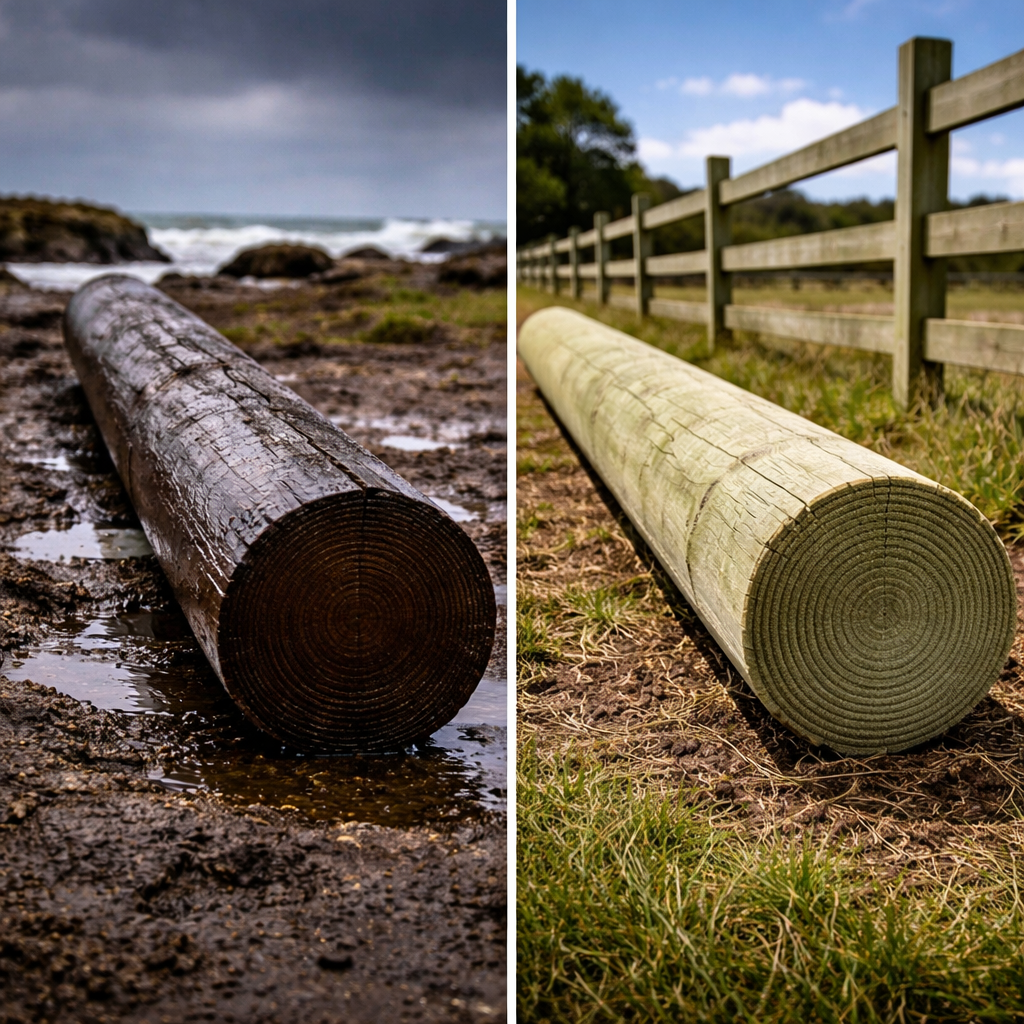
Choosing between CCA vs Creosote treated poles is one of the most important decisions you will make when planning a construction, fencing, or agricultural project. Many buyers assume that all treated timber performs the same, but this is not the case. The type of preservative used has a direct impact on durability, performance, and long-term value.
If you are wondering about the lifespan of treated poles and timber, know that it’s not primarily about the treatment you choose, but whether you are using the correctly treated poles and timber in the right applications
In South Africa, the two most commonly used timber preservatives are CCA (waterborne) and Creosote (oil-based). While both are highly effective, they behave very differently and are suited to different applications.
The Purpose of Timber Preservation
The main purpose of timber preservation is to protect wood from fungal decay, termites, wood-boring insects, and moisture damage. Eucalyptus poles consist of heartwood, which is naturally more resistant, and sapwood, which is vulnerable and requires treatment.
Important: wood preservation does NOT increase its strength, but only enhances durability. Proper treatment ensures deep penetration into the sapwood and long-term durability.
Treatment, whether CCA or Creosote, must comply with SANS standards to ensure performance.
Waterborne vs Oil-Based Preservatives
Waterborne Preservatives (CCA)
This type of preservative consists of inorganic chemicals dissolved in water, which act as the carrier during treatment. Once treated, the timber is clean to handle, odourless, and the preservative becomes fixed within the wood structure.
There are two types:
– Non-fixed (e.g., borates), which can leach
– Fixed (e.g., CCA), which bonds to the wood and resists leaching
Oil-Based Preservatives (Creosote)
Creosote is the primary oil-based preservative used in South Africa, sometimes combined with coal tar and wax additives.
It is applied using hot-and-cold open bath or vacuum pressure systems. The preservative is heated during treatment, making it thinner and easier to absorb, allowing deeper penetration into the timber. Unlike CCA, Creosote does not fix into the wood and can remain slightly mobile over time.
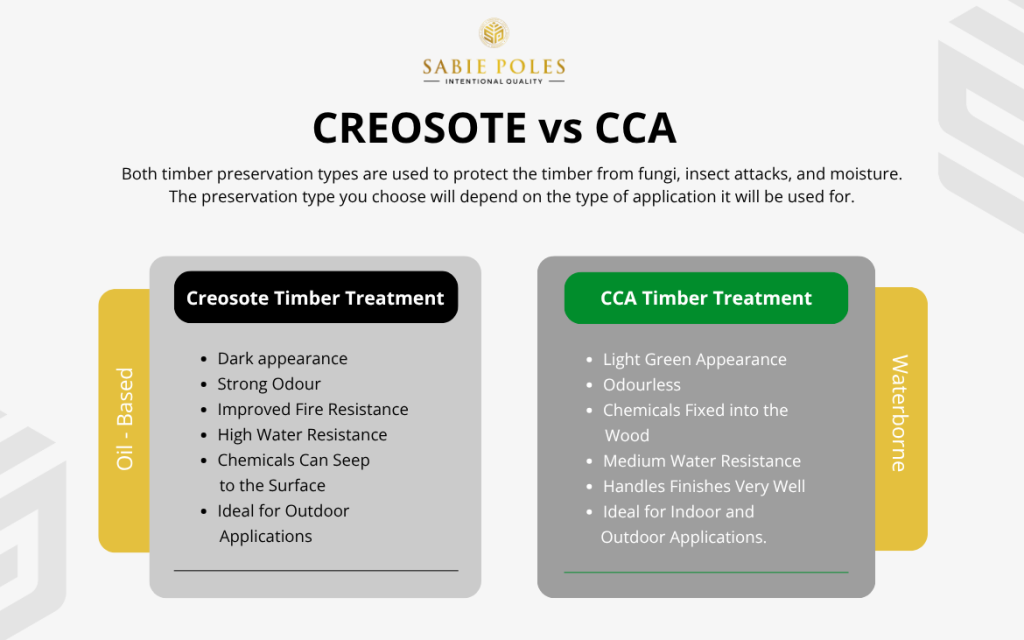
CCA vs Creosote: Key Characteristics Explained
While both types of timber preservatives serve the same primary purpose, protecting wood from fungi, insect attack, and moisture, they differ significantly in how they perform and where they are best used.
5 Main Characteristics of Creosote Treated Poles and Timber
- Dark, oily appearance
Creosote-treated timber has a dark brown to black finish with an oily look, which gives it a heavy-duty, industrial appearance. - Strong odour
It has a distinct, strong odour that is noticeable, especially when newly treated, which is why it is mainly used in outdoor environments. - Improved fire resistance
Creosote-treated poles are better able to withstand bushfires. During exposure to fire, a protective char layer forms around the pole, helping to limit damage. In addition, creosote does not promote any lingering after-glow once the fire has passed. - High water resistance
Creosote naturally repels water, helping to protect the timber against moisture absorption and reducing the risk of decay in wet conditions. - Can bleed or feel oily
Especially when newly treated or exposed to heat, Creosote can seep to the surface, leaving the timber feeling oily to the touch.
5 Main Characteristics of CCA Treated Poles and Timber
- Clean, light green appearance
CCA-treated timber has a consistent light green colour, giving it a clean and professional look that is suitable for visible applications. - Odourless
Once the treatment process is complete, the timber has no noticeable smell, making it easy to handle and suitable for a wide range of environments. - Chemically fixed in the wood
The preservative bonds with the wood structure during treatment, meaning it does not leach, evaporate, or move once properly fixed. - Protects against fungi and insects
CCA provides effective protection against fungal decay, termites, and wood-boring insects, ensuring long-term durability. - Easy to paint, glue, and install
The clean surface allows for easy finishing, making it suitable for applications where painting, gluing, or additional work is required.
Which is the Better Option?
At the end of the day, it all depends on your application:
- For most residential, agricultural, fencing, or visible applications (H3–H5 hazard classes): CCA edges out as the more environmentally responsible choice due to lower leaching risk after fixation, reduced toxicity perception, and easier compliance with handling/safety.
- For extreme wet/coastal/heavy industrial ground contact (including some H5 or H6 marine): Creosote (or dual CCA + Creosote) often performs better mechanically, which can make it more sustainable over the full life cycle by lasting longer and requiring fewer replacements.
Common Mistakes to Avoid
Many problems with treated timber poles are not caused by the product itself, but by poor decisions during the selection process. Avoiding a few common mistakes can save significant time and cost in the long run.
One of the biggest mistakes is choosing timber based on price alone. Lower-cost poles often indicate poor treatment quality or insufficient preservative penetration. While this may seem like a saving upfront, it usually leads to reduced lifespan and higher replacement costs over time.
Another common issue is using the wrong treatment for the environment. Different conditions require different solutions. For example, CCA-treated poles may not perform as well in constantly wet or high-moisture environments, while Creosote-treated poles are not ideal for residential or visible applications due to their oily finish and strong smell. The environment should always guide your choice.
Ignoring treatment standards is another critical mistake. In South Africa, timber treatment must comply with SANS regulations to ensure proper penetration and performance. Not all suppliers meet these standards, and using non-compliant products can result in early failure and inconsistent quality.
Looking for a More Environmentally Friendly Option?
We understand that environmental considerations are becoming increasingly important. While CCA remains a reliable and proven solution, we also offer alternatives.
Sabie Poles supplies Tanalith E-treated poles and timber on request, giving you flexibility based on your project and environmental preferences.
Interested in a quote for treated poles or timber? Get in touch with Danie. We’re here to help you make the best timber choices for your project. Call/Whatsapp: 072 838 2838 or email: sales@sabietimber.co.za. We are always here to assist. We export to all SADC countries and internationally. You can also view or download our product catalogue for construction timber.